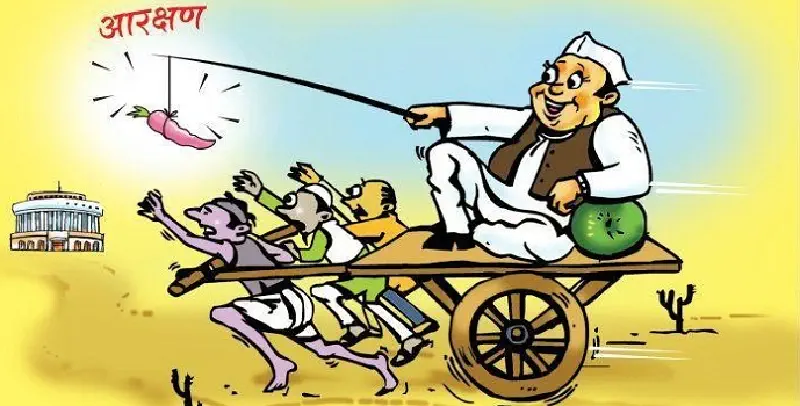
What is Reservation in India ?
-
“Reservation in India is a constitutional, quota-based affirmative action policy designed to address historical injustice and promote equality by providing preferential treatment to marginalized groups in education, government jobs, and legislatures.” (Source: Google AI Overview)
-
“The age-old caste system of India is responsible for the origination of the reservation system in the country. In simple terms, it is about facilitating access to seats in the government jobs, educational institutions, and even legislatures to certain sections of the population. These sections have faced historical injustice due to their caste identity. As a quota based affirmative action, the reservation can also be seen as positive discrimination.” (Source: Drishti IAS)
-
“Reservation in India is a system of affirmative action that aims to promote social justice by ensuring representation for historically disadvantaged communities in various fields such as education, employment, and politics. The system was introduced with the objective of rectifying centuries of discrimination faced by certain caste groups, particularly Scheduled Castes (SC’s), Scheduled Tribes (ST’s), and Other Backward Classes (OBC’s).” (Source: Law Bhoomi)
-
“Reservation is an ineffective, political solution to an economical problem” (Source: Ankush Fogaat)
The claimed reasons given for the requirement of Reservation:
-
Historical Injustice: To rectify centuries of social exclusion, systematic discrimination, and denial of basic rights faced by “lower” castes under the caste system.
-
Social Equality: To provide a level playing field for those who lack the social, cultural, and economic capital, resources and connections that more privileged groups have accumulated over generations.
-
Adequate Representation: To ensure that historically under-represented groups have a voice in the country’s decision-making processes, governance, and public services.
-
Positive Discrimination: Acts as a proactive tool to protect vulnerable groups from ongoing prejudice and to bridge the vast socio-economic gap in society
Claimed Constitutional Provisions for Reservation:
-
Article 15 (4, 5, 6): Enables special provisions for the advancement of backward classes and EWS in educational institutions.
-
Article 16 (4, 4A, 6): Allows for reservation in government jobs and promotions.
-
Article 334: Provides for the reservation of seats in the Lok Sabha and State Legislative Assemblies.
Historical Background of Reservation in India:
Colonial and Pre-Independence Era:
The roots of modern reservation lie in early 20th-century social reform movements and British administrative policies.
-
Early Initiatives (1882–1902): Jyotirao Phule first demanded reservation in education and government jobs for backward classes in 1882. In 1902, Rajarshi Shahu Maharaj, the Maharaja of Kolhapur, introduced a 50% reservation for non-Brahmin and backward classes, earning him the title “Father of Reservation in India”.
-
Communal Awards (1932): British PM Ramsay MacDonald proposed separate electorates for marginalized groups. This was fiercely opposed by Mohandas Karamchand Gandhi through a fast unto death, as he believed it would divide Hindu society.
-
Poona Pact (1932): A compromise between Dr. B.R. Ambedkar and Gandhi replaced separate electorates with reserved seats for “depressed classes” within a joint electorate.
-
Government of India Act (1935): Formally introduced the term “Scheduled Castes” (SC’s) and provided them with reserved seats and quotas in public services.
(Source: Google Gemini, Prompt: “history of reservation in India”, Edited by author)
Post-Independence & Constitutional Era:
With the adoption of the Constitution of India in 1950, reservation was institutionalized as a tool for “substantive equality”.
-
Initial Focus (1950): The Constitution provided 15% and 7.5% reservation for Scheduled Castes (SC’s) and Scheduled Tribes (ST’s) respectively in legislatures and government jobs.
-
The First Amendment (1951): Following the State of Madras v. Champakam Dorairajan case, the first amendment added Article 15(4) to legally protect reservations in educational institutions.
-
Mandal Commission (1979–1990): Established in 1979, the commission identified “Other Backward Classes” (OBC’s) and recommended a 27% quota. The V.P. Singh government implemented these recommendations in 1990, sparking nationwide protests.
(Source: Google Gemini, Prompt: “history of reservation in India”, Edited by author)
Judicial Landmark: Indra Sawhney (1992)
The Supreme Court’s Indra Sawhney v. Union of India judgment set the bedrock for modern reservation law:
- 50% Cap: Total reservations should not exceed 50% in a year, except in extraordinary circumstances.
- Creamy Layer: Affluent members of the OBC category were excluded from reservation benefits to ensure the most disadvantaged received help.
- No Reservation in Promotions: Initially, the court barred reservation in promotions, though subsequent amendments (e.g., 77th and 85th) eventually restored it for SC’s/ST’s.
(Source: Google Gemini, Prompt: “history of reservation in India”, Edited by author)
Recent Developments: (2019–Present)
-
EWS Quota (2019): The 103rd Amendment introduced a 10% reservation for Economically Weaker Sections (EWS) of the general category, making economic status a standalone criterion for the first time.
-
Women’s Reservation (2023): The 106th Amendment (Nari Shakti Vandan Adhiniyam) seeks to reserve 33% of seats for women in the Lok Sabha and State Assemblies.
-
Sub-classification (2024): In a historic 2024 ruling, the Supreme Court permitted states to create sub-quotas within SC/ST categories to target more deprived subgroups.
(Source: Google Gemini, Prompt: “history of reservation in India”, Edited by author)

Systematic Breakdown by The Author:
Centuries of Injustice:
- No targeted, systematic, generational Injustices were ever done on the basis of caste by Hindus on others Hindus.
- All Hindus irrespective of caste, as an entire lineage has faced historical, continuous, Injustices.
- The varna system was purely designed on the basis of division of labour, not on the basis of Ancestry. There was no upper or lower varna, there was only different varna’s. It was an inclusive system not an exclusive one.
- From thousands of years to today, Hindus are killed on basis of being a Hindu by The Infiltrator’s.
- The intent and the hope behind the ancient systems was for an inclusive society, where one would be able to achieve their aspirations and wishes through their actions.
Now, I cannot say that in the long, long history of Sanatan, that an individual or a group would not have faced any injustice. Yes, some would have faced some kind of injustice, but that is Human nature which occurs in isolation irrespective of any kind of factors. But this is also true that it did not happen by the design of the society at large or small. It was not a systematic outcome or even a systematic glitch but a fact of humans, we are a species which is capable of violence and cruelty, but we, as in us Hindus, do not enjoy or celebrate cruelty or violence, be it for the animate or for the inanimate. We were a civilization which was the closest to metamorphosing from our primitive biology of a smaller and weaker species to a planetary-dominating one in the entire history of mankind be it in the past, present or even in the future.
Social Equality
- This concept is completely illogical.
“Social equality is the state in which all individuals within a specific society have the same status, rights, and opportunities. (Source: Google Gemini, Prompt: “what do you mean by social equality”)
-
First, individuals within a specific society based on the basis of anything, cannot all have the same status as an individual. Having status in a society and having status as a citizen are completely, completely different concept. Your status in a society is decided with respect to multiple factors such your assets, your influence, your power, your respect, etc. and by the society as a whole. Now the equal status that should and can be given to all is “constitutional status”. You as a citizen have the same status as all citizens, which is not the same for a non-citizen. Such is also the case which used to happen between a king and his subjects. BTW, Bharat did not have the concepts such as “nobility by birth only”, and in front of the king a ruling class and a farmer had the same status as of a subject.
-
Second, having same rights does not imply giving every right to every person. We as in, we humans have developed a Consciousness according to which we have a moral obligation towards other human beings for the purpose of coexistence. Towards this goal, we devised some baseline expectations from ourselves and other humans alike, such as common decency. So for meeting this obligation of our societies we created something called in the constitution as fundamental rights. Now fundamental rights is the moral expectation of us form ourselves and fundamental duties is the moral expectation of ours from others. Now these should be same for all people for them to coexist. So don’t confuse “same rights” implying all rights.
-
Third, having same opportunities here similarly, does not inherently imply having all opportunities at your disposal. This is a moral virtue not a moral obligation. Now you might be thinking what is the difference. The difference is obligation is meant to be obliged irrespective of your wishes, whereas adherence to a virtue is optional with respect to your wishes. So, if a person or an institution (which also includes a state) wishes to enact or adhere to such a virtue, that does mean you coerce or compel someone else to also adhere to your virtue. As such the constitution cannot provide equal opportunities in all aspects to all. It can, however impose this virtue on itself, to provide opportunities at Its disposal, equally to all. Therefore, the constitution does not have any kind of moral argument to force others to adhere to provide equal opportunities to all.
Now let me give you the correct concept which can be used as a reason for Reservation:
“Economical Upliftment”: To help those who are economically backward, due to reasons beyond their control, achieve a baseline quality of Life.
Adequate Representation:
“To ensure that historically under-represented groups have a voice in the country’s decision-making processes, governance, and public services.”
-
“Historically under-represented”. Even if someone or some group or some section was under-represented in the past, what gives them the right to under-represent others in the person due to their past. You need to think hard about what I just said. If one is wronged in the past, then you make it right for the present and don’t let it happen in the future. But if you instead ask for special privilege on based on that you were deprived in the past, then what you are doing is simply depriving others in the present of what you were deprived in the past. And hence the cycle gets made of wronging and being wronged.
-
“Representation in governance and public services”. Why? On what moral or logical basis should this happen? Now all possible answers to this question would be fundamental flawed and structurally sound. Why must there be a democratic system in the role of governance, i.e, executive and public services. What I am trying to say is, the concept of representation is a democratic idea which should be used in the democratic process, i.e, in electing and ruling. There is absolutely no need of a democratic process in the act of governing. The executive is a functionary part of the governmental system not the democratic system, their job is not to decide the nature of governance but is to execute it. For that purpose the only kind of condition that can be imposed for such positions, is Competence.
-
Now let’s address the social reason which is given to have people be admitted on the basis of factors other than their ability to perform what is required of them:
-
“If only people of other groups are in a position of authority than they will treat me differently in negative deviation from how they would treat people from their own group. So, me with my, soo biggg brain though of a solution, I will demand that people from my group be given that position, so that I would not be treated differently. Wowww, I came up with such a brilliant idea, Go me.”
- You Blithering Idiot. He could cut my balls, so I also have to have the ability to cut his balls, and Then we will celebrate the cutting of balls. Let’s begin now, First you are playing on possibilities. It is not a given that you will always be wronged by every person not belonging to your groups, and also it’s not a guarantee that the person from your group will always treat you favorable. You know, the real intent behind this idea is not to get same treatment, but to get a more favorable treatment for yourself. If a person differentiates with you unfairly, for any reason, then you should ask for a way to get justice in such incident. The fundamental problem is not that you are in some way different from him, but that he wants you to be different from him in a negative deviation. If I were a smart person, I would ask to have that position be filled by someone who is the most brilliant, in every possible way. For example, if you are on an airplane, would not want the pilot of that plane to be the best in the world, instead of someone who could be above-average but belong to your group or someone is also above-average but does not belong to your group and also differentiate with people. What I am trying to get through is that, you are asking for the wrong thing, You are not asking to be treated same, you are not asking to be given world-case service, you are asking for a person who should belong to your group and therefor would not have a reason to differentiate with you on the basic of affiliation, while hoping that such a person would treat you fairly and be able to do the job, with no guarantee.
-
“My group’s population comprises 15% of total population, so we should have at least 15% of all authoritative positions. A completely fair ask, don’t you think so, I am only asking for what my ‘haq’.”
- Bloody Moutiya!!!. You ain’t entitled to shit. Note my words. When you are 15%, you get the voting percentage of 15%. Your population has no other ‘haq’ than this for the amount of population you might have. One has no basis to ask for percentages of numerous things on the basis of their population percentage. 1+A/=1A, (function is not defined).
-
Adequate Representation is carried out through voting. Every vote has same value. Every person has one vote. If you claim you are not adequately represented than that can only mean that you are not able to vote or your have a higher number of voters for a single seat in comparison to the rest of the seats which have a significantly smaller voter numbers than yours, only in these two conditions would it be logical and mortal correct to claim that adequate representation is not being carried out for you.
-
Ideas like 50% of the population is women, so 50% of seats should be occupied by women is utterly! Incorrect. 100% of women are voting, and their representation is being done through their votes not through the gender of the person seating on the seat. If a female candidate is more adept than she can win the election and claim the seat, if a man is more adept and the female voters wants the best person for that seat, then they will elect him, and thus be represented. But by forcing seats to be only be competed by a woman, you are actually depriving all the voters be it male or female of their freedom to choose and also depriving the male candidates to take part in elections, which is purely discrimination of the basis of gender.
-
The same which I wrote above, goes for other types of restrictions on any kind of position/role. Such as ST or SC or EWS or OBC or age or ethnicity or whatever.
Positive Discrimination:
-
This one, man, I didn’t even know such a concept exist before researching for this article. I mean I knew it was discriminator, but I thought they just didn’t accept that it was. You know, I can explain this entire topic with just one comparison with two words.
- Positive : Discrimination :: Righteous : Rape
-
Now for those who want analysis, let’s talk. The beauty of discrimination is that its non-discriminatory. Really, let me explain, I discriminate, the other person gets discriminated because well he can’t stop it and I can do it. Now at some-point in time there will come a day when he would discriminate, and I would be discriminated for the same reason, because I can’t stop him, and he can do it. So you see the act of discrimination does not discriminate, it can be done by all, and it can be done to all. And there lies in the beauty. It’s like Bone-chilling metal, if you touch it will burn, and it will be cold. Now simile aside, there is no such thing as positive discrimination. Discrimination is Discrimination. And if you think u could end discrimination by discriminating, then you are a bigger fool than…., I don’t even know who I could compare you too. Anyway.
Claimed Constitutional Provisions for Reservation:
-
The fuck do I care. Yeah!, the fuck should I care for what reasons are given. Seriously, it’s only a written piece of paper. And I don’t mean any dis-respect. But at the end of the day, its only paper, and if you think it’s more than that, then I ask you, can you as A citizen who acknowledges it as more than a piece of paper, even be able to enforce 50% of the principles and values which it was being giving when it was made. And I am taking about the aspirations of the people not as in technically.
-
You see, a book needs you to interpret it, you don’t need a book to interpret you. A person gives a book meaning, a book does not give a meaning to person. What I am trying to get through too you is that, do you need some kind of book or paper to know right and wrong, just or unjust. I can go into the technical details of the articles and clauses of the constitution of India along with the founding principles and moral values like other people who can as well. But in doing so we forget, that we are humans and not machines which first need input to get an output. We can give output without input. You don’t need a book or a person to define to you that the act of rape is a horrendous cruelty of unimaginable suffering. A piece paper is changed so easily, there is nothing in the constitution that can’t be altered. But no one can alter ones inherent conciseness of right and wrong. So instead of giving weight to words written on paper, please think of giving weight to your own truths.
-
Reservation in today’s form is unconstitutional, it goes against equal rights, equal opportunities, natural justice, non-discrimination, and what not.
-
For technicality, give more weight to language; for morality give more weight to the intent.
My Conclusion & Remarks:
Is Reservation Right:
Reservation is an extremely complex and sensitive social, political and economical “Question”.
The aspiration of the people towards Reservation was upliftment, empowerment and advocation in all aspects of their life. Now was this aspiration fulfilled through Reservation? It has not been. But was the people’s aspiration wrongful? No. Then what went wrong? A solution by the name of reservation was promised. It was given, but it did not solve the problem. This is the unadulterated reality.
Now what to do?
What is done is done, don’t let the past compromise you coming future.
Let’s use a systematic approach: Identify, Simplify, Justify, Modify, and Verify.
-
At a Fundamental level, what do we actually want from Reservation?
- To have a better life.
- How cam we get a better life?
- By, Having money, having health, having justice, being educated, having safety, and by having human life actual worth something.
- How cam we get a better life?
- To have a better life.
-
What were our Blunder’s?
- Wanting elite positions which were not even handful. Thinking uplifting some people to the top would inversely help people from the bottom rise up. Wanting privileges not resources. Not thinking for the solution by ourselves but asking the politician to even think of the solution and then solve it as well.
-
What could be some possible solution?
- Becoming educated by obtaining practical and actionally education, not just having a degree or marksheet in hand.
- How to gain knowledge?
- Ask for education for our children not educator position. Ask for the best teachers, you have got to use unconventional tools. Ask for high value, accessible education, digital education. Your end goal is to get your child educated not to see him go to a school every day, your priorities must be different, if you want to take a leap. You know it and I can know it that it’s not feasible to send every child to a physical college, ask for effective online collage courses with proper standardization and physical tests to maintain quality. You should not be asking for what the other person has, but be asking for what you actually need to close the gap between you and him.
- How to gain knowledge?
- Becoming educated by obtaining practical and actionally education, not just having a degree or marksheet in hand.
In the end, reservation as an applicable concept is faulted at its core.
The people require resources from the government not some promise which the majority won’t get. Gives us a way to have world-class education with low cost. We don’t want school building, we need a way to educate our children, going to a school is not the only option. We need ways to protect those who are weak. We practically cannot stop injustice. But we can give effective and acceptable remedy for it. Any person in this country should not be scared to callout being done injustice. Take accountability and responsibility, not political promises. Give it to only those who deserve it. And, Finally the criteria should be based on neediness not some Ambiguous criteria.